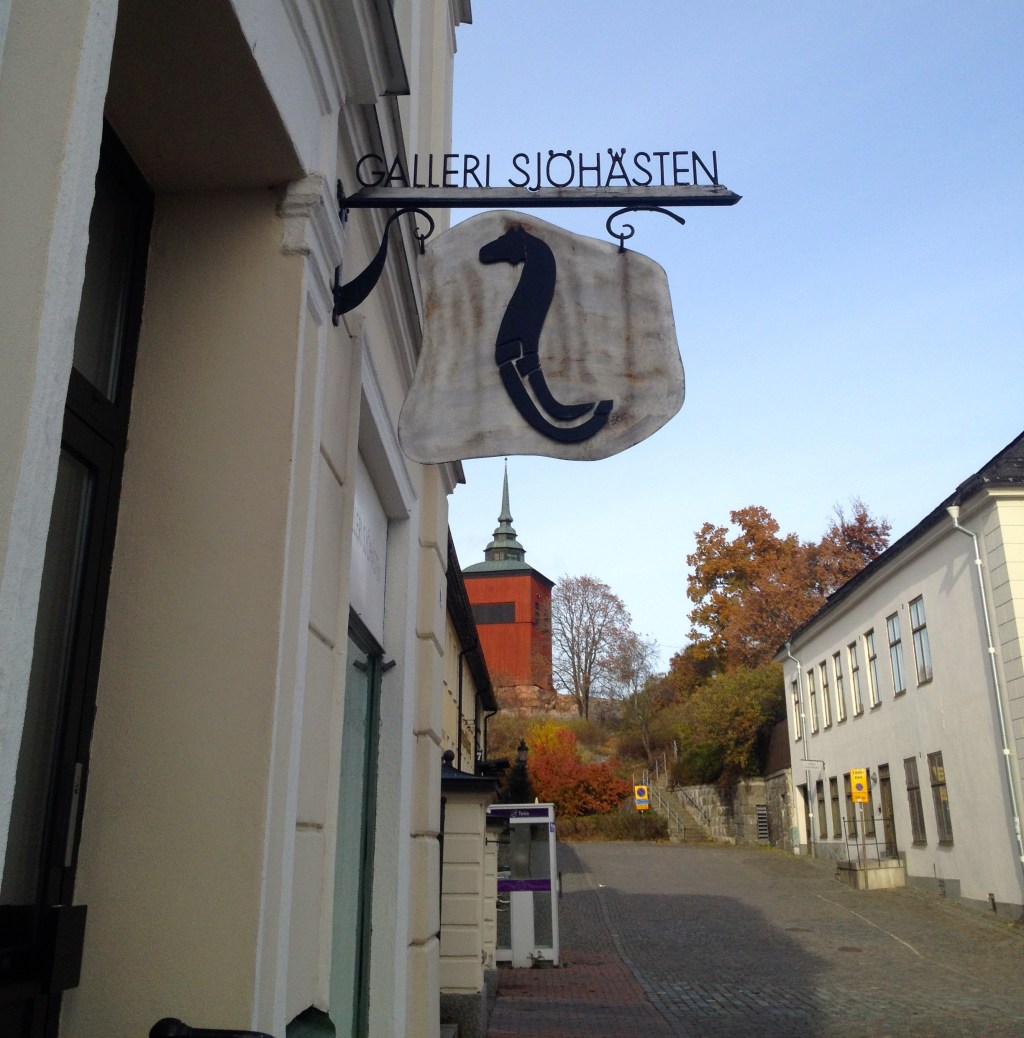
In reference to my visit to Galleri Sjöhästen today, I opted for a monochromatic ensemble consisting of gray trousers and a blazer. However, I incorporated a touch of color through my shirt and Vagabond shoes. Notably, some of the artworks displayed at the gallery featured gray surfaces, which was an unexpected coincidence.
On the final day of the exhibition featuring the works of Margareta Gelles (painting, acrylic/oil) and Claes Andersson (painting/mixed media), the exhibition presents a captivating juxtaposition of muscle cars and playful artistic expression. The general description encapsulates the essence of the exhibition, highlighting the harmonious blend of automotive aesthetics and artistic prowess.
In the majority of Margareta’s paintings, I discerned a character reminiscent of Disney. The other paintings convey expressions through gray fields and three-dimensional surfaces, which is the sole instance where I observed depth in her works. Notably, all other paintings lack three-dimensional compositions. This distinction is significant, in my opinion. Two of her paintings stand out as a stark contrast to her more whimsical artworks, even in their titles. These paintings are titled in Swedish, unlike the majority of her works that are titled in English. The paintings demonstrate her proficiency in employing diverse motifs while simultaneously incorporating her playful motifs. This observation has been confirmed. The paintings exhibit depth, movement, and adhere to conventional compositions and perspectives.
In Claes Oldenburg’s paintings, I consistently observe one or two automobiles, predominantly featuring significant power. The artist skillfully integrates these vehicles with text sourced from newspapers or his own compositions, effectively establishing a connection between the automobile and the text. Notably, the text is directly printed onto the canvas and subsequently covered with varnish. Towards the conclusion of my visit, I observed that Oldenburg employs a colored line in his artworks, employing a distinct hue for each painting, as a delineator between two sections. This technique is particularly noteworthy. The paintings are replete with traffic signs, lights, maps, and other ubiquitous imagery associated with the existence of substantial automobiles.
Summary of My Exhibition Visit
I hold diverse perspectives on the artworks displayed. I commend Clea’s mixed media creations and Margaret’s two stylistic paintings. However, I find the other more whimsical paintings excessively expressive and difficult to comprehend. I appreciate how Clea’s paintings allow for our imaginative interpretation. For instance, the artwork “Someone” aligns with my preferred style, predominantly employing black color, a code of ones and zeros, and a diminutive female portrait in the corner. It exemplifies how we can discern concealed elements within art. The utilization of code is evident in other artworks as well, albeit with distinct connotations.
Presently, we delve into the symbolic research of the most prevalent motifs. A vehicle with substantial horsepower evokes the symbols horse and car. To facilitate comprehension, I will provide a concise symbolic description of “Horse” and its connection to the automobiles in Claes’s paintings. The horse serves as a symbol of nobility, swiftness, and aesthetic beauty. Similarly, the automobiles in his paintings embody these qualities. Furthermore, they symbolize the acquisition and exertion of power. A galloping horse represents the power of nature and swiftness, but the symbolic significance of the horse varies depending on its color.
© Björn Blomqvist 2015-05-24
 Blomman's Art and Poetry Blog
Comment