My Colorful Ability
Everyday life is not just black or white. It is a color palette that captures impressions and the mind in all the colors of the rainbow. Synesthesia is a concept rather than an impression.
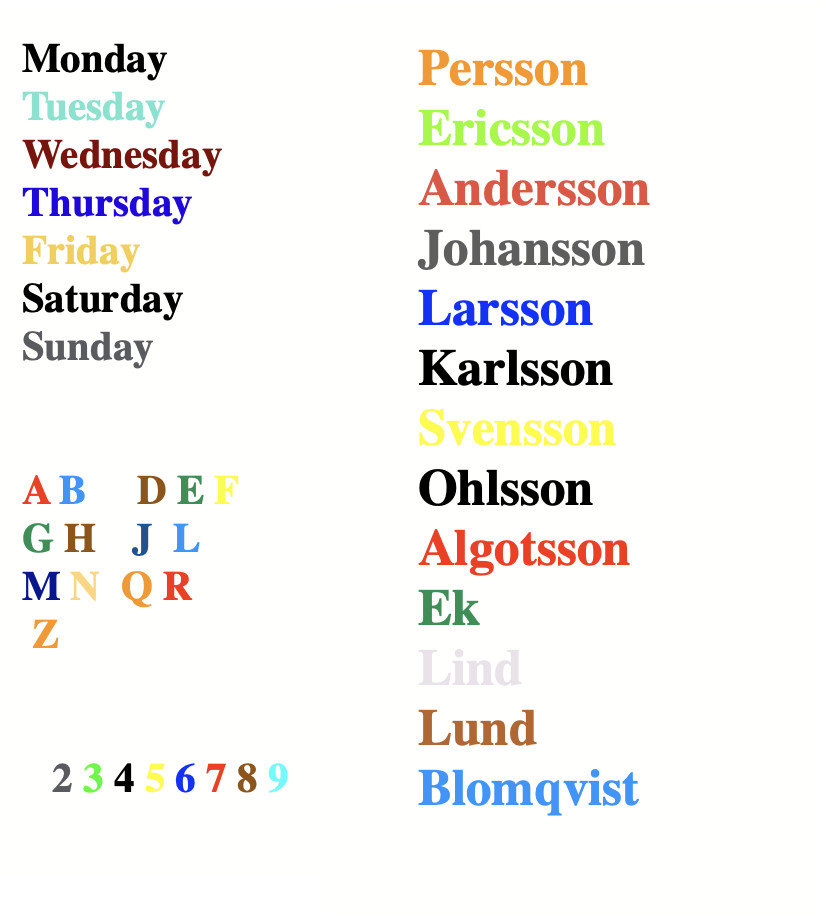
If I ask what your name is and you answer ”Eric”, then you are green. I am blue; Björn is a blue name, b as blue. If your name is Anna, you are red. Patrick is brown. Sofie is white. Johanna and Laura is red burgundy. Names and colors blend together. This highlights the fascinating connections I form through name and color. It’s obviously synesthesia!
If my name (Björn) is blue and sounds like an icy wind — what colors do you put on words?
Synesthesia
Synesthesia is a neurological phenomenon where senses are interconnected. Grapheme-color synesthesia, the most common form, involves automatic and consistent associations between letters or numbers and specific colors. These connections are often one-way and develop in early childhood. Synesthesia can manifest in other forms. For example, it link time units to colors. It can also connect music to visual experiences. There are about 70 types identified. While rare (0.001–4.4% of the population), it seems to run in families, suggesting a genetic basis. Experiences be projected (seen externally) or associative (internally perceived or ”felt”). Wikipedia
Research
According to research from the Karolinska Institute, synesthesia is briefly defined as a unique ability. In this condition, sensory impressions or thoughts are connected in unusual ways. For example, letters may be linked to colors, or sounds may trigger shapes.
Approximately four percent of the population has some form of synesthesia, which varies among individuals and is partially hereditary. Researchers believe that synesthesia is often triggered by concepts rather than direct sensory intake. This condition may help the brain make abstract ideas more concrete. Synesthetes sometimes have improved memory and are often creative, which explains the link to artistic professions.
There are theories about connections between synesthesia and autism1. These theories also link synesthesia to obsessive-compulsive disorder2. This is due to similar patterns in brain connectivity and attention to detail. Ongoing research is exploring these connections through twin studies and brain imaging.
Synesthesia is not a disability. It is often perceived positively. It enriches individual experiences and showcases the unique ways people interpret the world. Karolinska Institutet – A medical university
How – in what way
What does the color red sound like? Only someone with synesthesia can tell. One person hears a trumpet and sees triangles, another thinks of basketball and tastes waffles. A third perceives the number nine as a unique shade of pink. Synesthesia means ”simultaneous perception.” Current research suggests that often the concept or idea of something triggers the synesthetic experience. Karolinska Institutet – A medical university
My colorful everyday life
I became familiar with the term Synesthesia not too long ago. I was not aware of it from the beginning. When Synesthesia was described, it felt like my whole life was included in the expression. For years, I have seen words, numbers, dates, times, and letters in colors. It started when I was young.

This is how I see the year and how it is organized in my mind. Each month has a color. The days around Christmas and up to New Year’s Eve cover the entire upper line. Christmas weekend in the first part and in between comes the intervening days and finally the new year. That is the entire upper line covers a week, unlike the lower line which covers most of the year.
You can see how my synesthesia behaves. In the figure below, all the days of the week, a choice of names, and finally letters and numbers. What color associations do the words have with letters and numbers linked to dates, e.g., presented below.
Images – repetitive moments
Every time I shave, I get the same image of a specific person from my past. Another person from my past shapes my mind as I brush my teeth. The same goes for other recurring repetitive moments in everyday life.
I have other pictures and colors at other points. When I peel garlic, images of a specific person from my past come to mind. There are many more occasions when the same images come up during the same regular task.
Numbers
Three dates stood out. Each was marked with an important to-do on my calendar. They were like milestones of creativity waiting to be explored. In the same month but on three different dates, I experienced a vision of colors in front of me. It felt as if a painter had splashed vibrant tones across an endless canvas.
The 3rd is green 🟩. The 4th is black ⬛️. It is a deep contrast that evokes mystery and depth. I have an appointment with the doctor then. The 5th is yellow 🟨. It is a bright and cheerful shade that radiates warmth and optimism. It inspires me to embrace joy in every moment. Then it’s Christmas dinner with work colleagues.
Each of these colors carries its own unique energy. They send signals to my brain to memorize upcoming events. This process acts like a visual memory bank.
They fill my days with creativity and emotion. They are intertwined with my experiences. This is a choice from my everyday life and how it can take shape in my mind. The same is true when I experience certain moments.
Conclusion
My conclusion relies on names and words connecting to the color of their first letter. E is green, as is Eric, reflecting nature and renewal, seen in last names like Ek (oak). D is brown, mirrored by names like Donovan and Duncan. Many names starting with A are red, like Andersson and Anna.
This imagery can influence my perceptions, as the first letter can signify deeper meanings. I often worry about potential ”what if” scenarios. Instead of annotating appointments, I visualize them in color slots on my calendar. New colors and times can mix; 17:00 is red and 19:00 is light blue. If the colors blend, confusion arises, heightening my worries about timing and place.
Summary
Synesthesia is a condition where senses mix together, like connecting colors with names, letters, or numbers. For example, I see the name “Eric” as green and “Anna” as red. I also picture specific colors for days of the week and months.
Having synesthesia can boost creativity and memory, but it can sometimes lead to confusion when colors mix. About 4% of people experience synesthesia, which is inherited and is often linked to creativity and enhanced sensory experiences. Research looks into its ties to autism and OCD because of similar brain patterns.
In my daily life, synesthesia shapes how I see things, as everyday tasks bring up clear memories, colors, and images. For instance, certain dates remind me of green, black, or yellow, helping me to organize events in my mind.
© Björn Blomqvist 2024-11-24
- Autism, is a developmental condition that affects social interaction, communication, and causes repetitive behaviors. Symptoms can vary greatly, and while the exact causes are unknown, both genetics and the environment contribute. Early diagnosis and treatment can help improve the lives of those with autism. ↩︎
- OCD (Obsessive-Compulsive Disorder) is a mental disorder characterized by intrusive thoughts (obsessions) and repetitive behaviors (compulsions) performed to reduce anxiety. Common themes include fear of contamination, a need for symmetry, or fear of harming others. Treatment often involves CBT (Cognitive Behavioral Therapy) with exposure and response prevention, sometimes combined with medication. ↩︎

 Blomman's Art and Poetry Blog
Comment