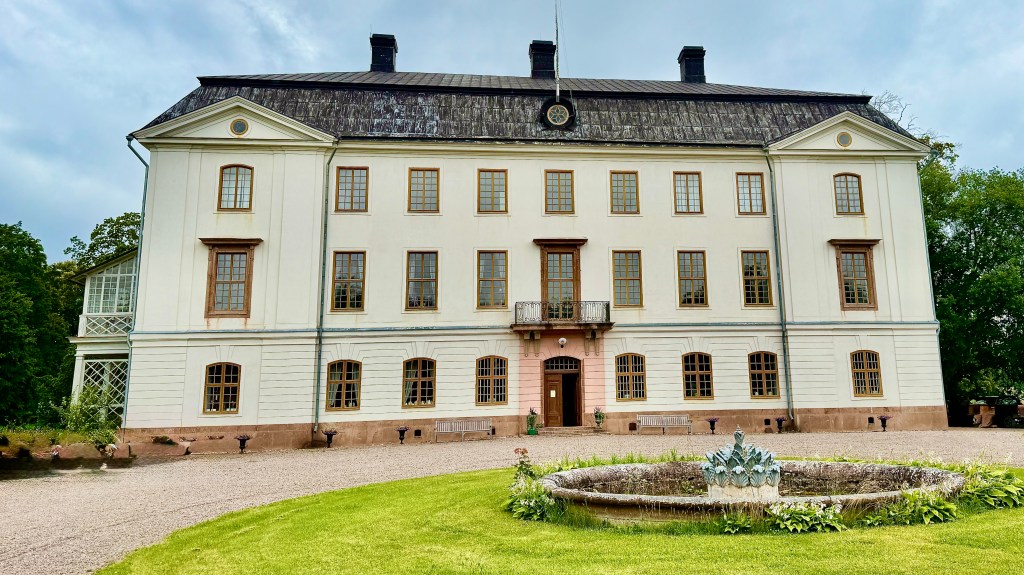
Ljungs Castle in Östergötland transports visitors to the 18th century, where grand halls, kitchens, and secret rooms come alive. Axel von Fersen’s love letters to Marie Antoinette feel as if they’re still being written. It’s a time-travel experience filled with laughter, offering an afternoon where the historic atmosphere returns.
Back in the neighboring county of Östergötland, there is a new attraction: Ljungs Castle. It’s just a 1-hour and 15-minute drive by car. Here is my account of everything I learned during the guided tour. The tour began in front of the castle. The guide provided a history of the castle and shared details about the estate.
The castle was constructed in 1776. It was completed in 1779 at the initiative of Field Marshal and politician Axel von Fersen the Elder. Architect Jean Eric Rehn designed the castle. It is built of stone and brick sourced from nearby quarries. This makes it a locally produced structure. The main building of the castle has three floors. One of the ground-floor rooms houses an exhibition dedicated to Jean Eric Rehn’s interior design.

The visit is a so-called theater tour. With a guide in period clothing, we are shown into different rooms. All the members of the ensemble are from Ljungs Slotts Bevarande. On the lower level, there are the kitchen and spaces for the servants.
We stood lined up along one short side. The magnificent kitchen in front of us had a stove, pantry, and china cabinet. We were given a scene from life in the 1700s among kitchen maids and servants.
Complaints were made about the food, and there were jokes about fake rats in the kitchen. One shot, and the medicine was taken. On the lower floor, there is a café and an exhibition about Jean Erik Rehn. Of course, there is a museum shop there as well. The walk continued to the second floor. This was the floor of the nobility. Here resided the owners of the castle, Axel von Fersen the Elder and his family.

The play is in the kitchen, and the entrance hall is in Rococo style. The second floor is in pure Gustavian style1.
We walked straight into the dining room. It was a large hall with dining tables. There was a tiled stove and an open fireplace at each end. Tiled stoves became common during the 17th century. On the walls hang portraits of the members of the Fersen family.
The dining room is located on the northern side of the castle, with windows facing north. This is to keep the room cooler during warm times. Here, a small play also took place before we were shown into the duke’s bedroom.
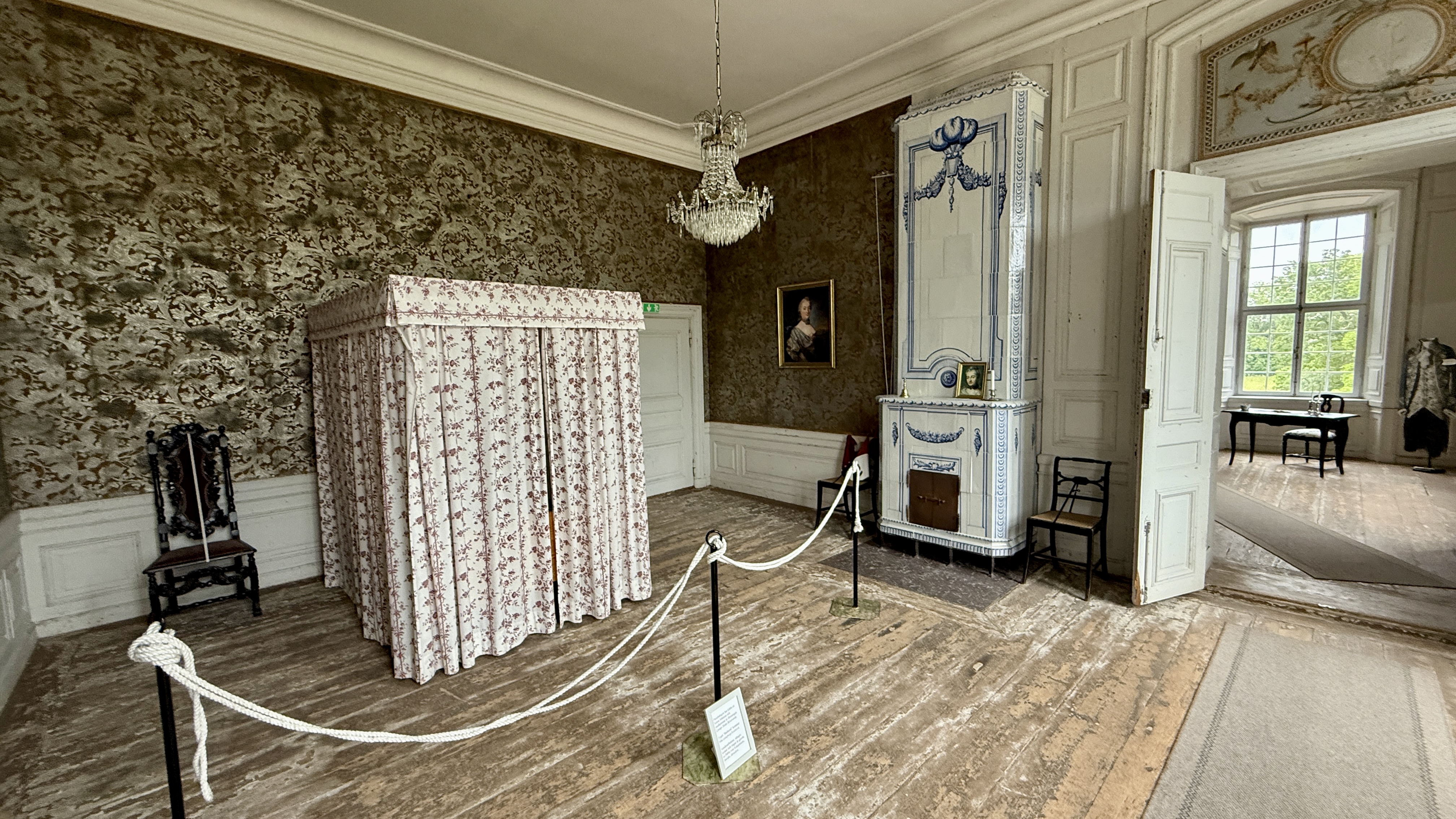
Axel von Fersen2 was tall and handsome. But the bed was only 1.65 m long. There was a bed canopy. It was meant to protect against cold and drafts, as well as to offer privacy. Even in there, the duke took care of his needs. In the play, the maid entered the room. She took out a bowl from under the bed. This represented his (you understand).
The pot was then taken up to the attic, where it was emptied. All odors wafted upward, far from where the people were. From the bedroom, the journey continued to the most interesting room: the office of Axel von Fersen the Younger3. It was there that he wrote letters to his beloved Marie Antoinette. They wrote to each other with invisible ink. The maid dusted and polished frantically in the office. She pointed out that von Fersen and Marie Antoinette had a secret code language. This secret code language was used in their correspondence.

Today, these letters have been deciphered. One can read about them in Förbindelsen – Marie-Antoinette och Axel von Fersen, which is based on letters and diaries. This book is authored by Kristina Ekero Eriksson. It was here in that Room we also heard the gossip about him and the Queen of France. There was an interesting moment of gossip about Axel von Fersen the Younger. He is also best known for his romance with the Queen of France.
The walk continued into the “fine salons,” as they say, literally into the salon. There, court was held. The gentlemen and ladies swung their shaggy legs, and music was played on the piano nearby.

I do not know what they danced to. But, the music was probably to the tones of baroque music’s sound. It also have been folk music in the spirit of the 18th century. In the next room, the governess lies slumped on the bed. She complains of a headache and nausea.
The maid then serves her a medicinal cure. She offers a glass with a concoction made from a whole array of ingredients. I didn’t manage to note these ingredients. The only thing I remember was a mixture of red and white wine, cinnamon sticks, and something else. It sounds like a rosé version of mulled wine.

In the next room, appearance was everything. A makeup room and a bidet on the floor were completely open for people in the house to see. At that time, one couldn’t be ashamed of cleaning oneself “down there.” Intimacy was almost nonexistent. The guide showcased the cold clothes she wore. She talked about her attire and explained how people dressed back then. It consisted of stockings, wedges, and petticoats, with a nightgown also included beneath everything.
A beauty spot (from the French “mouche4,”meaning “fly”) was an important detail in 18th-century fashion. It merged practical needs with aesthetic and symbolic values. We learned this when the guide showed hers on her right cheek.

At the End
It was there that the fun came to an end. The 1 hour and 10 minutes of guided tour, featuring elements of theater, was over. Dressed-up ladies in period-appropriate 18th-century attire and facts about both the palace and the von Fersen family had now concluded.
Back to the lower level and Rococo-style architecture, I was back in the 21st century. The museum shop and Ljung Church captured our last attention. Most of those from the Fersen family are buried there.
It was a long day in Östergötland County. We took a time travel back to the 18th century. The journey home to Södermanland County became a journey through time.
© Björn Blomqvist 2025-07-13
- Gustavian style is a Swedish take on French neoclassicism from the time of Gustav III (around 1770–1810). It includes light colors, straight lines, and classical elements like urns and ribbons. The furniture is graceful yet simple, typically painted in gray, white, or gray-green, suitable for Nordic light. It embodies ideals of simplicity and harmony and has aristocratic origins. Today, it stands for refined tradition in Swedish interior design. ↩︎
- Axel von Fersen the Elder (1719–1794) was a Swedish count, military officer, and diplomat. He was the ambassador to France and a member of the Council of State. A key figure in the Hat Party, he supported a pro-French, monarchist policy. This greatly affected Sweden’s domestic and foreign affairs in the 18th century. He was the father of the more well-known Axel von Fersen the Younger. ↩︎
- Axel von Fersen the Younger (1755 – 1810) was a nobleman and cosmopolitan. After his military training, he traveled across Europe. He mingled with French court circles. He became a close friend of Marie Antoinette. There were rumors suggesting he was her lover. He organized the royal family’s failed escape to Varennes in 1791 during the French Revolution. He served as an officer in both France and America. Later, he was promoted to major general in Sweden. In 1799, he became Marshal of the Realm. His diaries and letters give insights into Swedish politics and the French court life of the late 18th century. Today, he is remembered as a key figure linking Sweden and Europe. He is also recognized as a notable character of the Swedish Gustavian era. ↩︎
- “Mouche,” was a small piece of black fabric, often shaped like a fly. It was glued onto the face or chest. The purpose was to highlight the white, powdered skin. It also hid imperfections like scars or pimples. Most importantly, it showed that a person belonged to the higher social class that afforded makeup and accessories. ↩︎

 Blomman – Some Kind of Word Artist
Comment