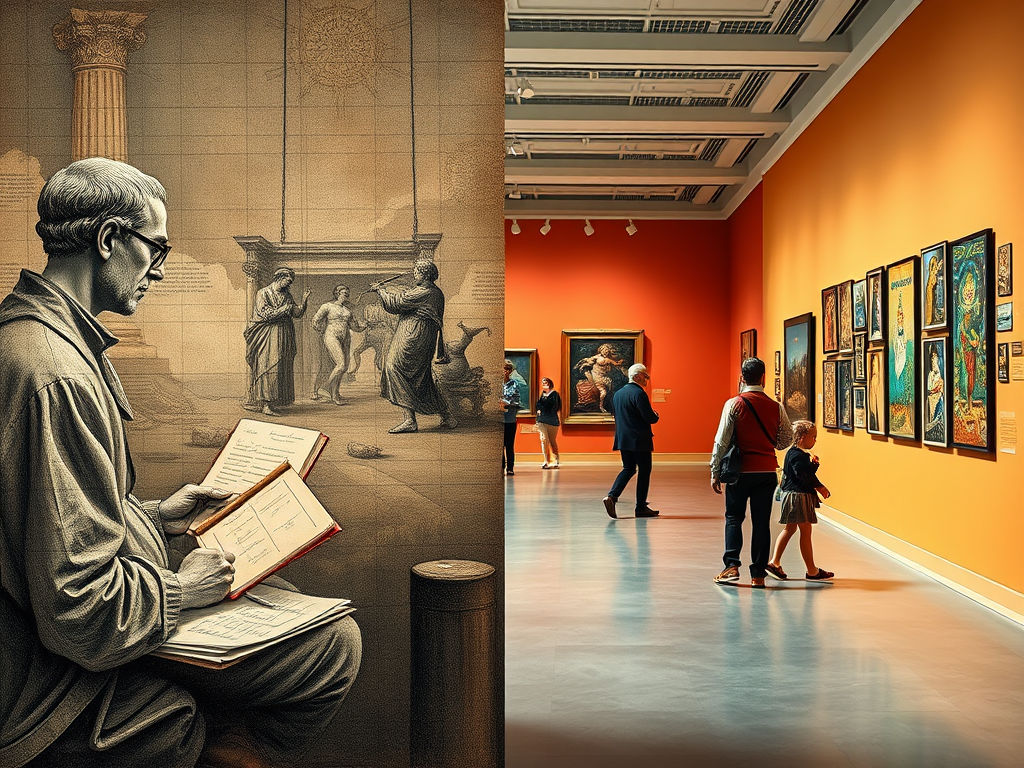
In this essay, I explore my art analysis method shaped by my studies and experiences, similar to Erwin Panofsky’s approach. I connect Panofsky’s interpretation levels with my modern view on art. This text is a personal reflection and a comparison of methods, blending intuition, symbolism, and perspective.
The point is that my method is remarkably similar to Erwin Panofsky’s (1892-1968) approach to analyzing art. Today, I’m more familiar with his theory, so I can identify similarities and some minor differences. In his method, the first step or level, which he calls “pre-iconographic,” involves observing what you see in the picture.
My analysis method is consistent, but I add some elements. I analyze colors, lines, forms, objects, surfaces, directions, and people, as well as movements and dimensions. I focus on depth, especially with 3D. I enjoy exploring 3D, particularly in Leonardo da Vinci’s central perspective style. I also look at the texture, techniques, and materials used in the artwork.
Another task that differs from Panofsky is how I analyze exhibitions. I focus on the entire exhibition instead of individual artworks. I spend less time on each piece. I allocate more time to researching the artist.
Background research is important for the second level of Panofsky’s method, which is iconographic. This level takes more time than I have available. However, there are times when I find enough information about the artist in the gallery folder. In these cases, I do a brief background check.
Furthermore, in level 2, a key part of my analyses is finding symbols. It’s also important to understand what different elements in the artwork mean symbolically. This includes icons too. I especially like discovering hidden or misunderstood icons and symbols. My bachelor’s thesis focused on symbols and icons, while my master’s thesis studied their significance in various artistic contexts.
In my final analysis, I’ve reached Panofsky’s third level of interpretation, which is iconological. I share my understanding of the painting’s message and discuss my feelings and thoughts about it. This creates a complete overview of my experience.
My main focus is on how I perceive the painting. I look at what it communicates and the feelings it stirs in me. I also notice the sounds and sensations related to the artwork. Ultimately, everything is subjective and personal. Even the artist may not fully understand my interpretation and feelings at that time. The artist’s goal is to evoke a reaction or specific emotion from the viewer.
The conclusion explores my artistic analysis and how it compares to Erwin Panofsky’s method. While Panofsky’s analysis includes many elements, my approach is more spontaneous, based on hopes and discoveries made during exhibitions. I aim to highlight the similarities between our methods, even before I learned about Panofsky’s approach.
There are other art historians and techniques to consider, including Svetlana Alpers and Heinrich Wölfflin. I aim to compare my approach to analyzing art with Panofsky’s method.
© Björn Blomqvist 2017-08-27
 Blomman's Art and Poetry Blog
Comment